Medical Director, Medical Office Force LLC | Athens, Georgia
Alumnus: SMS Medical College, Emory University, University of Alabama at Birmingham
Last updated on April 3, 2026
The modern medical front desk is under immense pressure, with staff juggling high call volumes and endless administrative tasks. At the Medical Office Force (MOF), we understand that introducing artificial intelligence can feel intimidating. However, before dismissing AI as just another tech trend the practice owners should ask themselves these three critical questions:
How much revenue and patient trust are you currently losing due to the industry average of 24% of inbound calls going to voicemail or being abandoned on hold?
If your front desk staff were completely free from navigating phone calls and answering repetitive questions about hours and insurance, how much more time could they dedicate to high-value, personalized patient care?
Is your practice currently equipped to capture and instantly assist the growing demographic of patients. And what about the patients who search for medical help and require immediate scheduling outside of the traditional 9-to-5 business hours?
The Frictionless Front Door: Explaining the AI Advantage
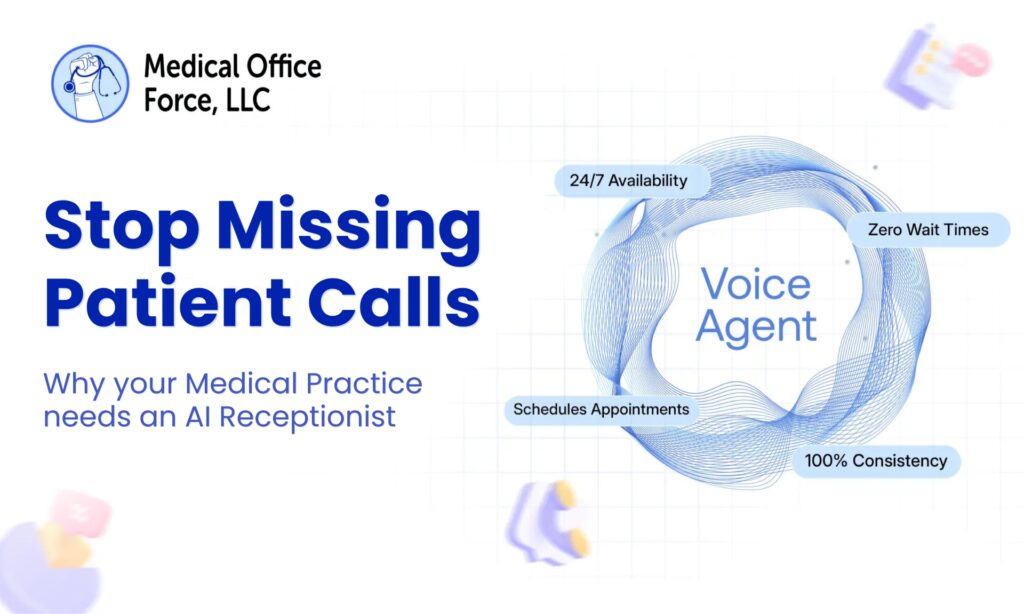
To answer the first question, practices lose immense value when patients are sent to voicemail. By adopting our unintegrated AI voice agents as a frictionless digital front door, every inbound call is answered instantly. The AI eliminates hold times, capturing revenue and preserving patient trust.
Answering the second question reveals the true value of AI: it is not a human replacement, but the ultimate complementary teammate. By absorbing the burden of repetitive inquiries such as answering basic FAQs, providing physical directions, and handling overflow routing. The AI frees your human staff to focus on complex clinical cases and empathetic in-office patient care.
Finally, to address the third question, illness and medical anxiety do not adhere to standard business hours. MOF ensures your practice remains available 24/7. A patient calling late at night gets an immediate, empathetic response and can even be scheduled for an appointment, effectively capturing off-hours demand rather than leaving patients frustrated.
Strict Constraints and Patient Safety
To build trust and ensure clinical safety, MOF helps clinics to strictly train their AI using a customized, highly structured knowledge base that prevents the system from hallucinating or generating false information. We implement hard algorithmic guardrails to guarantee the AI never provides unauthorized medical advice. If a patient asks a clinical question, the AI is programmed to trigger a fixed refusal script and immediately execute a seamless handoff to a human professional. Furthermore, the system continuously monitors conversations for urgent keywords, ensuring that any potential medical emergency is instantly escalated to your clinical team without delay.
Essential Features of an Unintegrated AI Agent
Based on leading industry white papers, a standalone AI medical receptionist must possess a specific suite of capabilities to succeed and deliver value without deep system integration. Key features include:
Smart Appointment Management: The ability to handle scheduling, rescheduling, and cancellations, along with sending conversational reminders to drastically reduce no-show rates.
Patient Intake and Triage: Guiding callers through structured digital questionnaires and intelligently routing urgent clinical needs to on-call staff.
Insurance and Financial Checks: Autonomously answering routine questions regarding accepted insurance networks, co-pays, and billing.
Effortless Prescription Refills: Processing 24/7 patient requests for medication refills and capturing the necessary details for human staff to easily follow up.
Multilingual Language Support: Communicating effectively in the caller’s preferred language to reduce miscommunication and improve equitable access to care.
Adopting an AI agent doesn’t have to be a disruptive overhaul. In fact, a structured 30-day phased rollout is the best way to rapidly improve clinic performance while building staff confidence.
Days 1-7 (Preparation & Getting Started): Begin by defining clear use cases and mapping out essential call flows for your specific clinic. Establish baseline metrics, such as current documentation time and hold times, to accurately measure future success.
Days 8-14 (Refining the Process): Test the AI in an isolated sandbox environment. During this phase, schedule brief, focused training sessions for your staff so they understand how to manage handoffs. Maintain your existing parallel phone systems temporarily to ensure a smooth, risk-free transition.
Days 15-30 (Building Confidence & Reliance): Officially launch the AI in a targeted capacity. Celebrate early wins with your staff, gather user feedback, and continuously monitor adoption rates. By day 30, the AI moves from being a new tool to a highly relied-upon operational teammate, drastically reducing the administrative burden.



Great insights on the benefits of AI in healthcare, thanks for sharing.
Great read—AI receptionists seem like a smart way to reduce missed calls while improving patient experience and efficiency.
Great insights on AI improving patient communication
Quiet helpful