Judah is the Marketing Lead at Medical Office Force. He specializes in new technology growth and on practical insights that help clinics succeed in a rapidly changing healthcare landscape.
Last updated on April 1, 2026
The Administrative Crisis and the Need for Automation
The modern medical practice is facing intense operational challenges. Increasing patient volumes, staffing issues, and administrative demands are posing significant challenges in providing access and efficiency in the clinics.
The front desk is overwhelmed. They are dealing with an influx of calls, messages, and scheduling requests. They are burnt out. This is impacting the overall patient experience and employee retention.
Additionally, medical practices are also losing a significant percentage of incoming calls. This is leading to delayed care, decreased satisfaction, and lost revenue.
Conventional solutions such as call centers and voice response systems are not providing the solution. Instead, it is removing the personal touch that is expected.
Artificial intelligence-based voice response systems are changing the way we handle calls. They are able to understand and manage requests in real time. However, it is important that we implement them as support agents.
Understanding the Market and Positioning Strategy
There are various options in the market for an artificial intelligence voice agent. Some systems are highly integrated, while others are quicker to deploy.
While the highly integrated systems are powerful, they also require time and effort. On the other hand, the quicker systems may not be as integrated.
The best approach would be to find a balance. First, implement the standalone system, and once the user trusts the system, move toward deeper integration.
AI Vendor Platform Comparison
Platform
Target Market
Integration Level
Key Strength
Medical Office Force
Small to mid-sized clinics
Low to Medium
AI voice agent for handling patient calls, reducing missed calls, and supporting front desk operations
DoctorConnect
Small to enterprise clinics
High
Full patient engagement system with strong compliance record
Sully.ai
Mid to large hospitals
Very high
Complete AI workforce with strong ROI
Talkie.ai
Specialty practices
High
Deep integration with major EMR systems
Infinitus
Insurance focused organizations
High
Handles complex communication workflows
My AI Front Desk
Small clinics
Low to medium
Quick setup and cost effective
OmniMD
Mid to large clinics
Medium to high
Predictive automation and analytics
Vocca.ai
High volume clinics
Low to medium
Natural conversational experience
UnityAI
Clinic networks
Medium
Multilingual and scalable
Smith.ai
Clinics needing oversight
Hybrid
Combines AI with human support
Voiceoc
Diverse patient base
Low
Multi channel communication
Designing an Unintegrated AI System for Immediate Impact
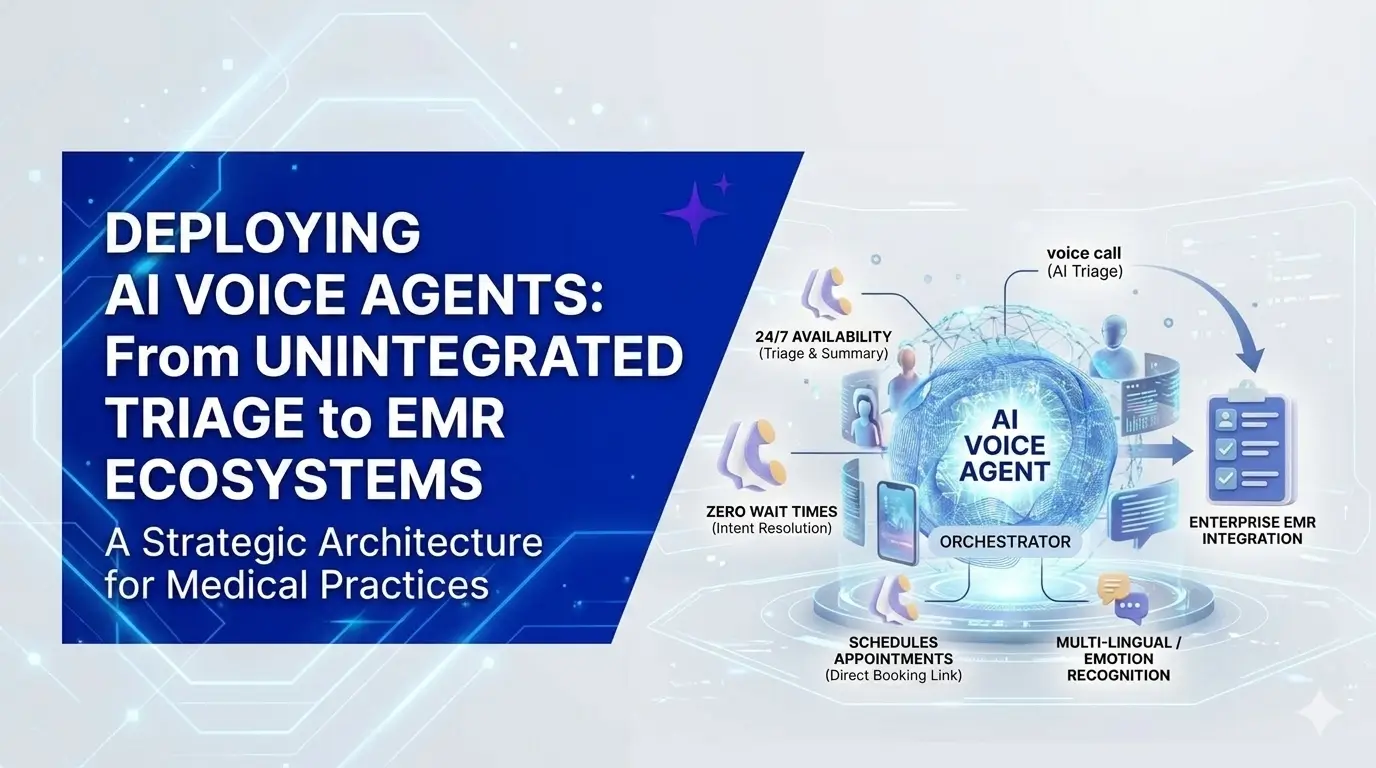
If access to the records is not possible, the system should still work effectively.
A good system should be centered on the understanding of the patient’s intent and the resolution of the request.
Instead of long recordings, the system should provide structured summaries.
This will enable the staff to act quickly without having to listen to the entire call.
In addition, the system can provide secure links to the patients through texts to enable them to make appointments.
Another factor to consider is the language of the patients.
Patients may change the language of the call as they talk.
A good system should be able to handle this.
The system should also be able to recognize emotional cues.
If the patient is upset or confused, the call should be passed to the staff with the summary of the call.
Managing Risks and Ensuring Safety
AI in healthcare must be carefully controlled. While it improves efficiency, it also carries risks if not managed properly.
AI Risks and Safety Framework
Risk
Impact
Solution
Misunderstanding patient intent
Incorrect responses or repeated loops
Ask clear follow up questions
Incorrect AI responses
Risk of misinformation
Use controlled and verified data sources
Giving medical advice
Legal and safety concerns
Immediate escalation to medical staff
Data errors
Scheduling conflicts or data loss
Confirm all details before finalizing
Emergency mismanagement
Delay in urgent care
Direct routing to staff immediately
Bias in responses
Unequal patient experience
Continuous monitoring and refinement
To ensure safety, the system must follow strict rules. It should never provide medical advice and must always route clinical concerns to qualified professionals.
Emergency situations must be prioritized, and patient data must be handled securely at all times.
The Role of Prompt Design and Staff Training
The effectiveness of an AI system also relies on the way it has been designed and the extent to which the staff understand it.
For accurate response, the instructions must be clear, and the way it speaks must be natural and conversational, as this would create trust in the patients.
Staff involvement in the implementation of an AI system is very important, as when they understand that it’s not replacing them but rather assisting, the process goes smoothly.
Implementation in Rural Healthcare Settings
Specific rural healthcare environments may have unique challenges, including limited resources and workforce shortages.
AI may help alleviate some of these challenges by reducing administrative tasks and improving patient communication.
The implementation of AI should be done gradually.
Training is important, as is leadership buy-in, to ensure successful implementation of AI in these environments.
30 Day Implementation Plan
Phase
Timeline
Focus
Phase 1
Days 1 to 7
Assess workflows and define goals
Phase 2
Days 8 to 14
Testing and pilot rollout
Phase 3
Days 15 to 21
Controlled live deployment
Phase 4
Days 22 to 30
Optimization and scaling
A phased rollout reduces disruption and builds confidence among staff.
Moving Toward Full Integration
Once it has been proven that the system is effective, then comes the time for further integration.
At first, it will be able to access internal knowledge sources for enhanced accuracy. Later on, it will be able to connect with scheduling systems and other applications.
Finally, comes the time for integration with medical records.
Frequently Asked Questions
What is an AI voice agent in medical practices? An AI voice agent is a system that answers patient calls, manages scheduling, and handles routine communication tasks in real time.
Should AI voice agents be integrated with EMR systems immediately? No, it is better to start with a standalone system and gradually integrate with EMR platforms once the team is comfortable.
Can AI replace front desk staff? No, AI is designed to support staff by handling repetitive tasks while allowing them to focus on patient care.
What are the risks of AI in healthcare? Risks include incorrect responses, misunderstanding patient intent, and delays in handling urgent situations. These can be managed with proper safeguards and human oversight.
Final Perspective
The success of AI in medical practices depends on strategy, safety, and trust.
Starting with a simple approach and expanding gradually allows practices to adapt without disruption.
AI voice agents are not replacements for human care. They are support systems that improve efficiency, reduce workload, and enhance patient experience.



Informative blog