Judah is the Marketing Lead at Medical Office Force. He specializes in new technology growth and on practical insights that help clinics succeed in a rapidly changing healthcare landscape.
Last updated on June 24, 2026
The Smarter Front Door for Modern Medical Practices
Why the Front Desk Is Breaking in 2026
Every medical practice depends on one critical moment: the first patient interaction.
For most clinics, that moment still happens over the phone.
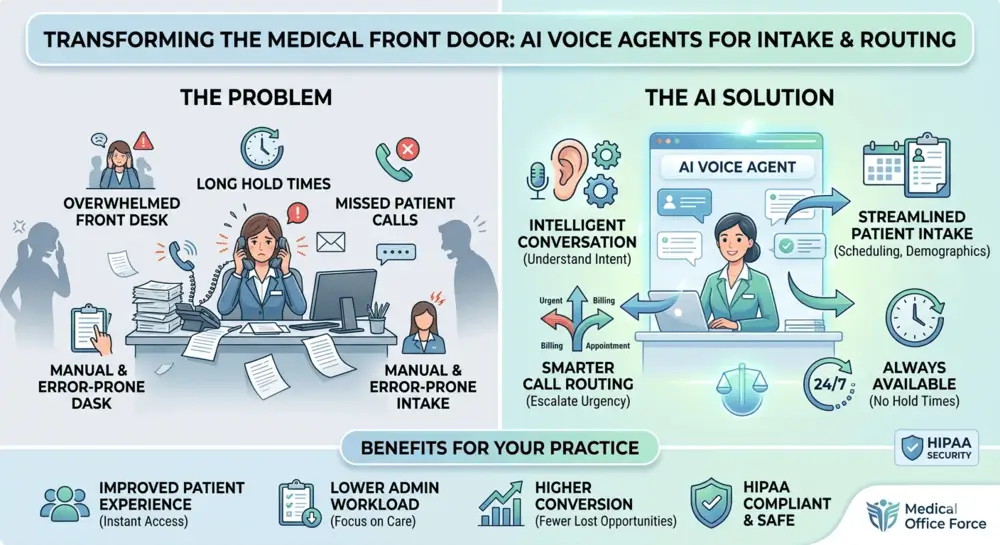
But today’s front desk is overwhelmed. Calls come in nonstop, patients expect instant answers, and staff are juggling check ins, insurance verification, and in person care at the same time.
The result is predictable.
Missed calls. Long hold times. Frustrated patients.
According to healthcare access data, many clinics miss a significant percentage of inbound calls, directly impacting patient acquisition and continuity of care.
This is where AI voice agents are changing the system.
What Is an AI Voice Agent
An AI voice agent is not a traditional phone tree.
It is an intelligent system powered by natural language processing that can understand, respond, and act on patient requests in real time.
Instead of pressing buttons, patients simply speak.
The system listens, understands intent, and completes tasks such as:
Scheduling appointments
Collecting patient information
Answering common questions
Routing urgent calls to staff
Unlike legacy systems, AI voice agents adapt to conversation, not scripts.
Why Patient Intake Is the Biggest Opportunity
Patient intake is one of the most time consuming and error prone processes in healthcare.
It requires collecting:
Name and demographics
Insurance details
Reason for visit
Medical history
When done manually, this leads to delays, incomplete data, and repeated questions.
AI voice agents simplify this process by handling intake before the patient even walks in.
Patients can provide their information through a natural conversation, and the system structures it automatically for staff review.
This reduces front desk burden and improves accuracy.
Smarter Call Routing Means Faster Care
Not every call should be handled the same way.
Some patients need immediate attention. Others just need basic information.
AI voice agents analyze intent in real time and route calls accordingly.
For example:
A patient reporting chest pain can be escalated immediately
A prescription refill request can be directed to the appropriate workflow
A new patient can be guided through scheduling without waiting on hold
This creates a system where urgency is recognized instantly.
The Impact on Patient Experience
Patients today expect healthcare to function like every other service industry.
They want:
Immediate response
Clear communication
Easy scheduling
Research from healthcare experience studies shows that patients are far less likely to wait on hold or leave voicemails. Most will simply call another provider if access is delayed.
AI voice agents solve this by ensuring every call is answered instantly.
No hold music. No missed opportunities.
Just access.
Operational Benefits for Medical Practices
The impact goes beyond convenience.
Practices that implement AI voice systems often see:



Smart approach to modernizing healthcare front desk operations. Thank you for sharing.
Great work, which makes the workflow easier than before.
Insightful look at access and operations
Well explained how an AI voice agent works. It’s awesome.
Amazing !!