Medical Office Force

Modern medical office front desk featuring a digital AI voice agent interface assisting with patient intake and automated call routing.

Share on

AI Voice Agents for Patient Intake and Call Routing

  • Judah Coody

    Judah is the Marketing Lead at Medical Office Force. He specializes in new technology growth and on practical insights that help clinics succeed in a rapidly changing healthcare landscape.

Last updated on April 22, 2026

The Smarter Front Door for Modern Medical Practices

Why the Front Desk Is Breaking in 2026

Every medical practice depends on one critical moment: the first patient interaction.

For most clinics, that moment still happens over the phone.

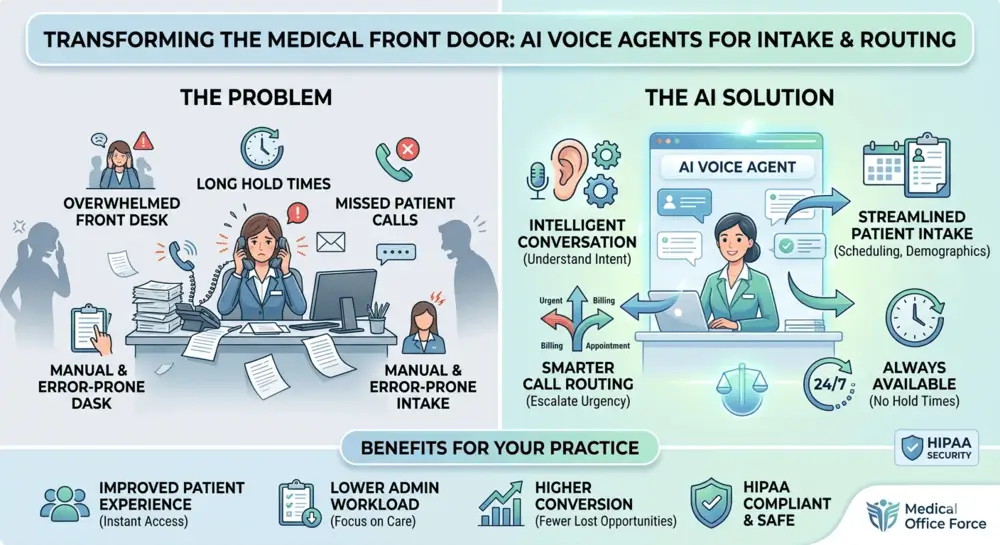
But today’s front desk is overwhelmed. Calls come in nonstop, patients expect instant answers, and staff are juggling check ins, insurance verification, and in person care at the same time.

The result is predictable.

Missed calls.
Long hold times.
Frustrated patients.

According to healthcare access data, many clinics miss a significant percentage of inbound calls, directly impacting patient acquisition and continuity of care.

This is where AI voice agents are changing the system.

What Is an AI Voice Agent

An AI voice agent is not a traditional phone tree.

It is an intelligent system powered by natural language processing that can understand, respond, and act on patient requests in real time.

Instead of pressing buttons, patients simply speak.

The system listens, understands intent, and completes tasks such as:

      • Scheduling appointments
      • Collecting patient information
      • Answering common questions
      • Routing urgent calls to staff

Unlike legacy systems, AI voice agents adapt to conversation, not scripts.

Why Patient Intake Is the Biggest Opportunity

Patient intake is one of the most time consuming and error prone processes in healthcare.

It requires collecting:

      • Name and demographics
      • Insurance details
      • Reason for visit
      • Medical history

When done manually, this leads to delays, incomplete data, and repeated questions.

AI voice agents simplify this process by handling intake before the patient even walks in.

Patients can provide their information through a natural conversation, and the system structures it automatically for staff review.

This reduces front desk burden and improves accuracy.

Smarter Call Routing Means Faster Care

Not every call should be handled the same way.

Some patients need immediate attention. Others just need basic information.

AI voice agents analyze intent in real time and route calls accordingly.

For example:

      • A patient reporting chest pain can be escalated immediately
      • A prescription refill request can be directed to the appropriate workflow
      • A new patient can be guided through scheduling without waiting on hold

This creates a system where urgency is recognized instantly.

The Impact on Patient Experience

Patients today expect healthcare to function like every other service industry.

They want:

      • Immediate response
      • Clear communication
      • Easy scheduling

Research from healthcare experience studies shows that patients are far less likely to wait on hold or leave voicemails. Most will simply call another provider if access is delayed.

AI voice agents solve this by ensuring every call is answered instantly.

No hold music.
No missed opportunities.

Just access.

Operational Benefits for Medical Practices

The impact goes beyond convenience.

Practices that implement AI voice systems often see:

  • Reduced call abandonment rates
  • Improved appointment conversion
  • Lower administrative workload
  • Better staff satisfaction

Digital health adoption data from the American Medical Association shows increasing use of AI tools to reduce administrative burden and improve efficiency
https://www.ama-assn.org/system/files/2023-02/ama-digital-health-study.pdf

This shift is not optional anymore. It is becoming the standard.

Safety and Compliance Still Come First

In healthcare, automation must be safe.

AI voice agents used in medical practices are designed with strict guardrails.

      • They do not provide medical advice.
      • They escalate clinical concerns.
      • They operate within defined workflows.

Most importantly, they are built to meet HIPAA requirements for handling patient information securely.

This ensures that efficiency does not come at the cost of safety.

Where Most Practices Get It Wrong

Many clinics hesitate to adopt AI because they think it replaces staff.

It does not.

It supports them.

The goal is not to remove humans from the system.
The goal is to remove friction.

When repetitive calls are handled automatically, staff can focus on:

      • In office patient care
      • Complex cases
      • Building relationships

That is where real value exists.

Self Assessment: Is Your Practice Ready for AI

Ask yourself:

      1. Are patients frequently placed on hold or sent to voicemail
      2. Does your front desk struggle during peak hours
      3. Are you missing new patient opportunities due to call volume
      4. Is your intake process slow or repetitive
      5. Do patients complain about access or responsiveness

If the answer is yes to any of these, your current system is limiting your growth.

Frequently Asked Questions

1. Will patients feel comfortable talking to AI

Yes. Modern systems are conversational and natural, making interactions simple and intuitive

2. Does AI replace front desk staff

No. It reduces repetitive workload and allows staff to focus on higher value tasks

3. Can AI handle complex patient requests

It can handle most routine requests and escalate complex situations to staff when needed

4. Is patient data safe

Yes. Systems are designed to meet healthcare privacy standards including HIPAA compliance

5. How does AI improve appointment scheduling

It removes delays by allowing patients to book instantly without waiting on hold

6. Can AI work after hours

Yes. It provides continuous availability, capturing opportunities that would otherwise be lost

7. Is this only for large practices

No. Small and mid sized clinics benefit significantly from improved efficiency and access

The Bottom Line

The front desk is no longer just a desk.

It is the entry point to your entire practice.

If that entry point is slow or inconsistent, everything downstream suffers.

AI voice agents create a system where every patient is heard, every request is handled, and every opportunity is captured.

Take Action

If your practice is missing calls, struggling with intake, or losing patients due to delays, it is time to rethink your front door.

Medical Office Force helps practices implement AI driven systems that improve access, efficiency, and patient experience.

Because in healthcare, access is not just convenience.

It is care.

For more information, write to contact@medicalofficeforce.com


Share Your Thoughts

Leave a Comment

Your email address will not be published. Required fields are marked *