

AI voice agents are rapidly changing how medical practices communicate with patients. They answer calls instantly, schedule appointments, route urgent concerns, and reduce front desk overload.
But one question continues to come up repeatedly among physicians and administrators: “Can AI actually handle patient communication securely and remain HIPAA compliant?”
The short answer is yes. But only when it is designed correctly.
Why Security Matters More Than Ever
Healthcare communication contains some of the most sensitive information possible:
- Patient names
- Medical histories
- Insurance details
- Medication information
A communication failure is not just frustrating. It can become a serious legal and compliance issue. That is why HIPAA compliance cannot be treated as an optional feature in healthcare AI systems. It must be the foundation.
According to the U.S. Department of Health and Human Services, HIPAA establishes national standards to protect sensitive patient health information from unauthorized disclosure. Practice managers can review these statutory frameworks on the official HHS HIPAA Portal.
What HIPAA Compliance Actually Means
Many people misunderstand HIPAA. It is not simply about “keeping information private.” HIPAA requires healthcare organizations and technology partners to ensure:
- Patient information remains secure
- Access is restricted appropriately
- Data transmission is encrypted
- Communication systems prevent unauthorized disclosure
This becomes especially important when automated systems handle ai patient communication directly with patients over the phone.
How Modern AI Voice Agents Protect Patient Information
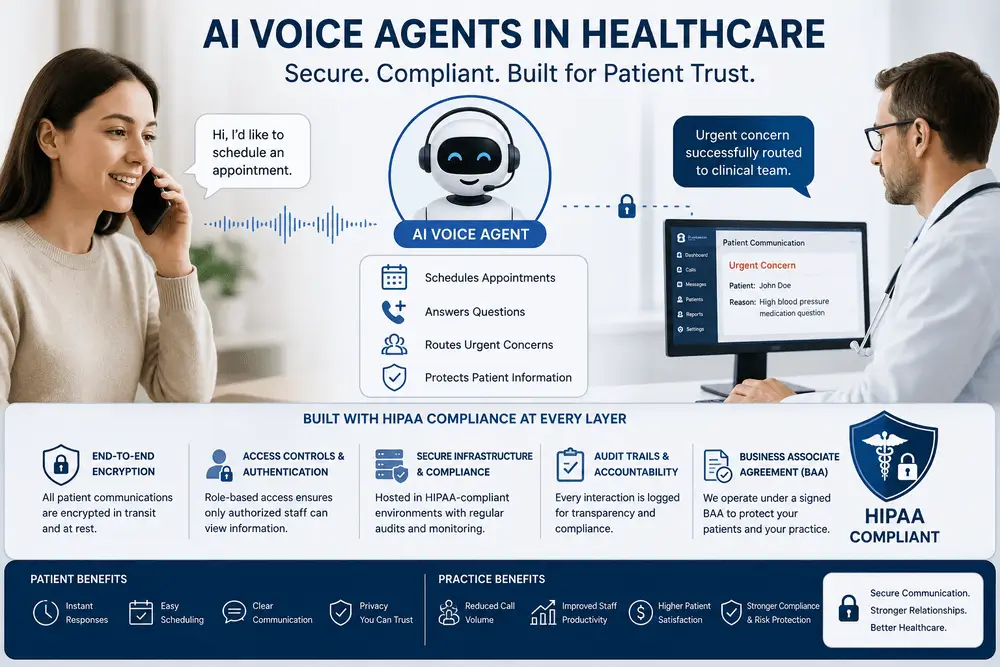
Properly designed healthcare AI systems operate within strict security frameworks. At Medical Office Force, HIPAA focused communication systems are built around several critical layers of protection.
Secure Data Encryption
Patient communication data must remain encrypted both during transmission and while stored. This prevents unauthorized access and protects sensitive information from interception. According to the Office for Civil Rights under HHS, encryption is one of the strongest methods for reducing healthcare data security risk. You can view their guidance via the official HHS Risk Analysis Guidelines.
Controlled Access and Authentication
Not every staff member should access every patient conversation. Modern AI systems use permission based access controls to ensure only authorized personnel can review protected information. This creates accountability and improves audit tracking.
Intelligent Call Routing Without Information Exposure
One of the biggest advantages of AI voice agents is structured routing. Instead of patients repeating sensitive information multiple times, AI systems securely collect and direct communication appropriately. Urgent medical concerns can immediately escalate to clinical teams while routine administrative issues are handled efficiently. This improves both privacy and patient experience.
Reduced Human Error
Many healthcare communication breaches happen through simple human mistakes:
- Missed voicemails
- Wrong transfers
- Incomplete documentation
- Shared patient information in open environments
AI systems reduce these risks by standardizing workflows and minimizing communication inconsistency.
Why Patients Are Becoming More Comfortable With AI
Patients primarily want three things from communication systems: Quick response, clear answers, and confidence their information is secure. Long hold times and fragmented communication often create more frustration than technology itself.
Digital health adoption research from the American Medical Association shows patients increasingly value responsive and technology enabled healthcare communication systems, outlining why patients prefer ai over on hold waiting slots. Clinic workflows see marked improvement when these criteria are met. You can read the comprehensive findings in the AMA Digital Health Study. When AI is implemented correctly, patients often perceive communication as faster, clearer, and more reliable.
HIPAA Compliance Is Not Automatic
This is where many practices make mistakes. Not every AI tool is designed for healthcare use. Consumer level AI systems may lack:
- Healthcare encryption standards
- Audit controls
- Business Associate Agreements
- Protected data handling protocols
This is why practices should never implement generic AI communication tools without healthcare specific safeguards.
The Future of Patient Communication
Healthcare communication is shifting rapidly. Patients expect immediate access, faster scheduling, and better responsiveness. Practices that rely entirely on traditional call workflows often struggle with missed calls, staff burnout, patient dissatisfaction, and revenue leakage. Deploying an enterprise architecture built for high call volume management helps solve these operational challenges while maintaining security and compliance when deployed properly.
A Simple Self Assessment
Ask yourself honestly:
- Does our practice miss patient phone calls regularly?
- Are patients frequently placed on hold?
- Do communication delays frustrate staff and patients?
- Are after hours support calls handled efficiently?
- Do we have structured systems protecting patient communication data?
If the answer is no, your communication infrastructure may need modernization.
Frequently Asked Questions
1. Can AI systems truly be HIPAA compliant?
Yes, when built specifically for healthcare with proper safeguards and encryption.
2. Is patient information stored securely?
Healthcare grade AI systems use encrypted and access controlled environments.
3. Can AI replace human staff completely?
No. AI supports staff by handling repetitive communication tasks efficiently.
4. What makes a healthcare AI system different from regular AI tools?
Healthcare systems include HIPAA protections, audit controls, and secure infrastructure.
5. Are patients comfortable speaking with AI voice agents?
Many patients prefer immediate response over waiting on hold for long periods.
6. Does HIPAA apply to phone based AI systems?
Yes. Any system handling protected health information must follow HIPAA standards.
7. What is the biggest communication risk for medical practices today?
Delayed response, inconsistent workflows, and unsecured patient information remain major risks.
The Bottom Line
AI in healthcare is not just about automation. It is about creating faster, safer, and more reliable patient communication systems. When implemented correctly, HIPAA compliant AI voice agents improve operational efficiency while protecting patient trust and privacy. The future of healthcare communication will not simply be digital. It must also be secure.
Take the Next Step
If your practice is exploring AI voice agents or communication automation, security and compliance must come first. Medical Office Force helps practices implement HIPAA focused AI communication systems designed specifically for healthcare operations.
Because in modern medicine, patient trust depends not only on clinical care, but also on how securely and efficiently communication is handled.
Useful overview of secure HIPAA compliant AI voice agents in healthcare.