Medical Director, Medical Office Force LLC | Athens, Georgia
Alumnus: SMS Medical College, Emory University, University of Alabama at Birmingham
Last updated on May 4, 2026
What is the CMS ACCESS Model Payment Structure?
Summary: The CMS ACCESS Model replaces fee-for-service volume with Outcome-Aligned Payments (OAP), where up to 50% of revenue is tied to hitting clinical targets over a 12-month care period.
The Centers for Medicare & Medicaid Services (CMS) is reshaping reimbursement with the ACCESS Model, starting July 2026. This system introduces Outcome-Aligned Payments (OAP), a system that rewards physicians based on measurable patient outcomes rather than the sheer volume of services provided.
As a practicing cardiologist, I know that a “new payment model” often translates to an added administrative burden. However, understanding how OAP payments work is the only way to protect your practice’s cash flow while delivering high-quality, coordinated care.
What Are Outcome-Aligned Payments (OAP)?
Outcome-Aligned Payments (OAP) are recurring, per-beneficiary payments designed to incentivize clinical success.
For eCKM and CKM patients in rural areas, CMS adds a $15 fixed payment during the Initial Period to offset the costs of distributing connected devices like blood pressure cuffs and wearables.
The 50% Withhold Rule: Your Practice’s Risk vs. Reward
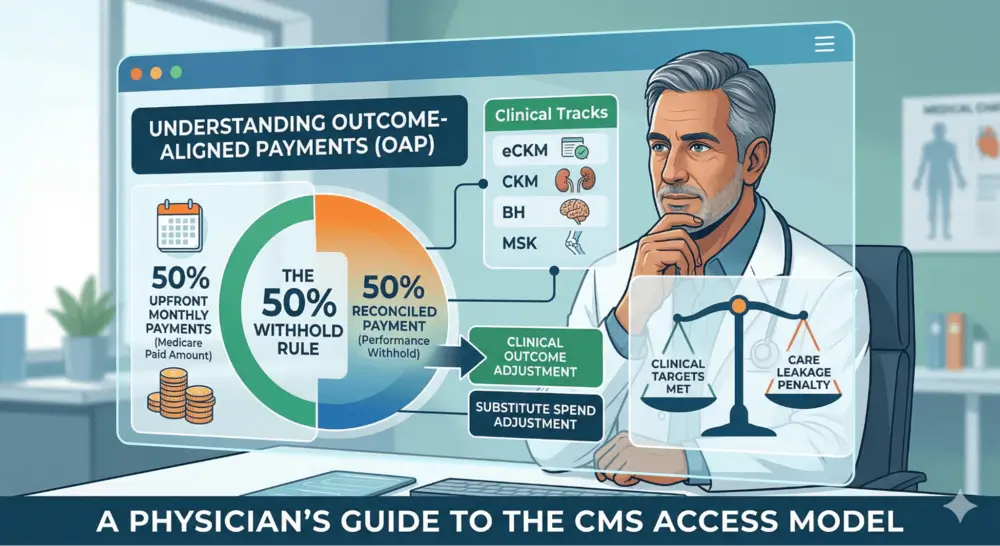
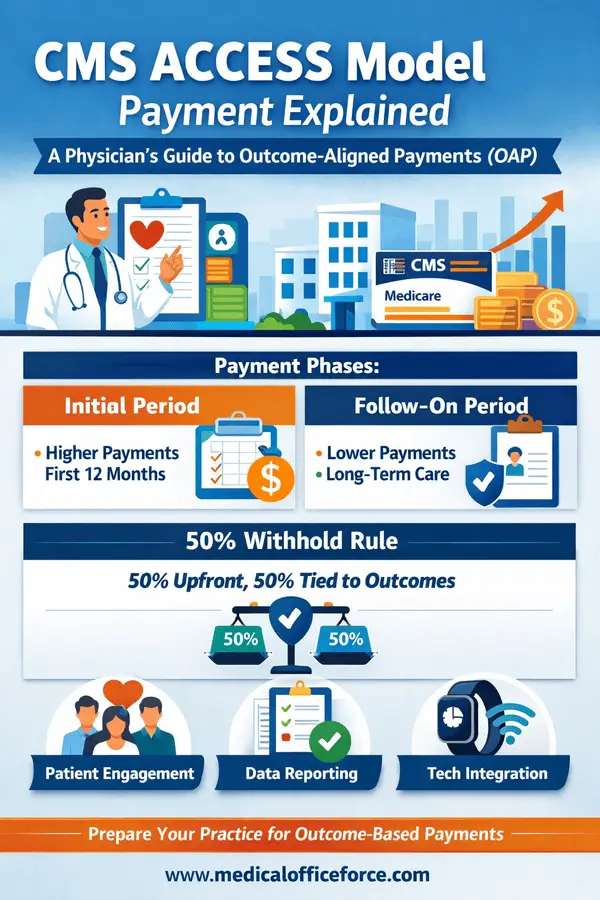
The most critical detail for practice managers is the 50% withhold. CMS pays only half of the Medicare portion monthly; the rest is reconciled after 12 months.
To receive that second 50%, practice must meet the two targets:
Outcome Attainment Threshold (OAT): 50% Target At least 50% of your aligned patients must meet their clinical goals (e.g., 15 mmHg SBP reduction or 1% HbA1c drop).
Substitute Spend Adjustment (SST): 90% Threshold This penalizes “care leakage.” If your patients seek defined “substitute” services from outside providers above the 90% threshold, your reconciled payment is reduced.
Dr. Agrawal’s Insight: From my experience at Emory and UAB, I’ve seen how patient leakage happens when communication breaks down. In this model, if a patient goes elsewhere for a psych eval or a device setup that you were supposed to coordinate, it costs you directly.
Reporting Requirements in the ACCESS Model
Data compliance is now a prerequisite for payment. Timely reporting is critical for maintaining eligibility and payments.
Baseline Data: Must be submitted via FHIR API within 60 days of alignment. Miss this, and the patient is unaligned, meaning you cannot bill.
Quarterly Reporting: Required every 70–110 days to maintain active billing status.
End-of-Period Reporting: For MSK and Behavioral Health tracks → Success can be reported at 180 days → Continued payments if patient remains stable
Challenges Physicians Will Face
Transitioning to the ACCESS Model comes with operational challenges:
Increased data tracking requirements
Higher dependency on technology systems
Risk of patient leakage affecting revenue
Administrative complexity in reporting
How to Succeed Under the ACCESS Model
To thrive under this payment structure, practices must shift from reactive to proactive engagement.
Key strategies:
Automate Outreach: You cannot manually call every patient to check their BP. You need AI-driven systems (Implement automated patient communication systems).
Remote Patient Monitoring (RPM): Use the rural add-on to fund the devices that provide the data you need for the OAT (Invest in remote patient monitoring (RPM))
Clinical Oversight: Ensure your Medical Director is reviewing outcomes quarterly, not just at the end of the year.
AI Call Handling: Use AI-driven call handling to reduce missed patient interactions.
Why Patient Engagement is Critical in OAP Models
Under Outcome-Aligned Payments, success depends on keeping patients consistently engaged.
If patients:
Miss follow-ups
Seek care elsewhere
Drop off from care plans
→ Your performance metrics and payments might suffer.
Expert Insight from Dr. Agrawal
This model makes active care delivery non-negotiable.
If you lose track of a patient and they receive care elsewhere, it’s not just a clinical gap, it’s a direct financial loss under the reconciliation model.
Conclusion: Opportunity or Risk?
The CMS ACCESS Model is a fundamental shift. For physicians in Georgia and across the country who are willing to embrace tech-enabled care, it offers:
a predictable,
monthly revenue stream.
For those who stay with manual processes, the 50% withhold represents a significant financial risk.
FAQ: CMS ACCESS Model Payment
What is CMS ACCESS Model payment? It is a value-based payment system where physicians are reimbursed based on patient outcomes instead of service volume.
What are Outcome-Aligned Payments (OAP)? OAPs are payments tied to achieving measurable clinical improvements in patients.
What is the 50% withhold rule? CMS pays 50% upfront and holds the rest until performance metrics are met at the end of the care period.
What happens if reporting deadlines are missed? Patients may become unaligned, and providers may lose the ability to bill for their care.
How can practices improve ACCESS Model performance? By improving patient engagement, reducing care gaps, and adopting technology solutions for communication and monitoring.
Call to Action (CTA)
If your practice is preparing for the CMS ACCESS Model, now is the time to strengthen your patient engagement and communication strategy.


For more information, write to contact@medicalofficeforce.com
Share Your Thoughts
No comments yet — be the first to comment!