
How AI Enhances the Front Desk Receptionist
(Without Replacing the Human Touch)
In any medical practice, the front desk is far more than a place where phones are answered and appointments are booked. It is the first point of contact for patients, the gateway to care, and a critical driver of both patient satisfaction and practice revenue. Every incoming call represents a patient seeking help, clarity, or reassurance.
Despite its importance, the traditional front desk is often stretched thin. Busy schedules, staffing shortages, peak-hour call volumes, and growing administrative demands make it difficult for teams to keep up. Calls go unanswered, voicemails pile up, and patients become frustrated. Over time, these small breakdowns quietly affect patient retention, revenue, and staff morale.
This is where AI-enhanced front desk receptionists are changing the landscape,not by replacing human staff, but by supporting them in practical, meaningful ways.
The Reality of Front Desk Challenges in Healthcare
Front desk teams manage a wide range of responsibilities every day, including:
- Answering and routing phone calls
- Scheduling and rescheduling appointments
- Verifying patient information
- Responding to insurance-related questions
- Managing referrals and supporting clinical staff
All of this happens while maintaining professionalism, empathy, and accuracy.
During peak hours, this workload becomes overwhelming. Phones ring continuously, patients wait on hold, and staff are forced to rush conversations. Even the most skilled receptionist can handle only one call at a time. When multiple calls come in simultaneously, the patient experience often suffers first.
Missed calls typically lead to voicemail, which many patients view as a dead end. Some may try again later, but many do not. In healthcare, this results in lost appointments, delayed care, and missed revenue. Over time, ongoing pressure leads to burnout, turnover, and further operational strain.
What Does “AI-Enhanced” Actually Mean?
An AI-enhanced front desk does not mean replacing your receptionist with a robot. Instead, it means using artificial intelligence as a digital assistant that supports your existing team.
AI front desk systems are built to handle high-volume, repetitive tasks that consume time but do not require human judgment or emotional intelligence. These systems can:
- Answer calls instantly
- Collect basic patient information
- Schedule appointments using predefined rules
- Confirm visits and send reminders
- Provide standard practice information
By offloading routine interactions to AI, front desk staff gain the breathing room needed to focus on tasks that truly require a human touch.
How AI Supports Daily Front Desk Operations
One of the greatest advantages of AI is availability. Unlike human staff, AI does not take breaks, call in sick, or log off at the end of the day. It is available 24/7 to respond to patient inquiries during lunch hours, after clinic hours, or early in the morning.
AI also manages scheduling with consistency and accuracy. It follows practice-defined rules such as provider availability, appointment types, and visit durations. This reduces errors, prevents double-bookings, and improves overall workflow efficiency.
For patients, this means:
- Immediate responses instead of voicemail
- Clear instructions instead of confusion
- Faster access to appointments and information
Reducing Front Desk Burnout
Front desk burnout is a growing concern in healthcare. Constant interruptions, repetitive questions, and the pressure to multitask take a toll on mental health and job satisfaction. When staff are overwhelmed, even the best employees struggle to meet patient expectations.
AI acts as a pressure-release valve by:
- Absorbing call volume during busy periods
- Handling common questions like office hours or directions
- Managing appointment confirmations and reminders
This allows staff to work at a more sustainable pace. When receptionists are less stressed, they are more patient, attentive, and engaged, directly improving patient experience and team morale.
Improving Accuracy and Consistency
Human error is unavoidable, especially in fast-paced, high-volume environments. Small mistakes in patient details, appointment information, or communication can lead to scheduling conflicts, billing issues, and dissatisfaction.
AI systems excel at consistency. They capture patient data in a standardized manner, follow workflows precisely, and record information accurately every time. This creates smoother handoffs between the front desk, clinical teams, and billing departments.
The result is:
- Fewer downstream errors
- Less administrative rework
- Improved operational efficiency
Preserving the Human Touch
One of the most common concerns about AI in healthcare is the fear of losing empathy. Patients want to feel heard and supported, especially when they are anxious, unwell, or facing complex medical decisions.
This is why AI should never operate in isolation. The most effective front desk models use a hybrid approach, where AI handles routine interactions and seamlessly transfers patients to human staff when emotional or complex support is needed.
In this model, AI enhances, not replaces the human experience. Patients still speak with real people when it matters most, without the frustration of long wait times or unanswered calls.
Why Staff Adoption and Trust Matter
Technology only delivers value when people trust it. If front desk staff see AI as a threat to their jobs, adoption will fail. However, when AI is positioned as a tool that reduces workload and stress, acceptance grows quickly.
Successful practices involve staff early, communicate clearly, and provide proper training. Over time, many receptionists become strong advocates for AI because they experience firsthand how much easier their workday becomes.
Is AI Right for Every Practice?
AI front desk solutions are not one-size-fits-all. Successful implementation requires thoughtful setup, customization to practice workflows, and a clear escalation path to human staff.
Practices must invest time in training the system on:
- Scheduling rules
- Provider preferences
- Patient communication standards
When implemented correctly, most practices see meaningful improvements within 30 to 60 days.
The Bigger Picture: Better Care Through Better Access
At its core, healthcare is about access. When patients can reach a practice easily, schedule appointments without friction, and receive timely responses, they are more likely to stay engaged and compliant with care.
AI-enhanced front desk receptionists help remove access barriers while protecting what matters most the human connection. They allow practices to grow, improve efficiency, and support staff without sacrificing patient trust.
The Future of the Front Desk Is Collaborative
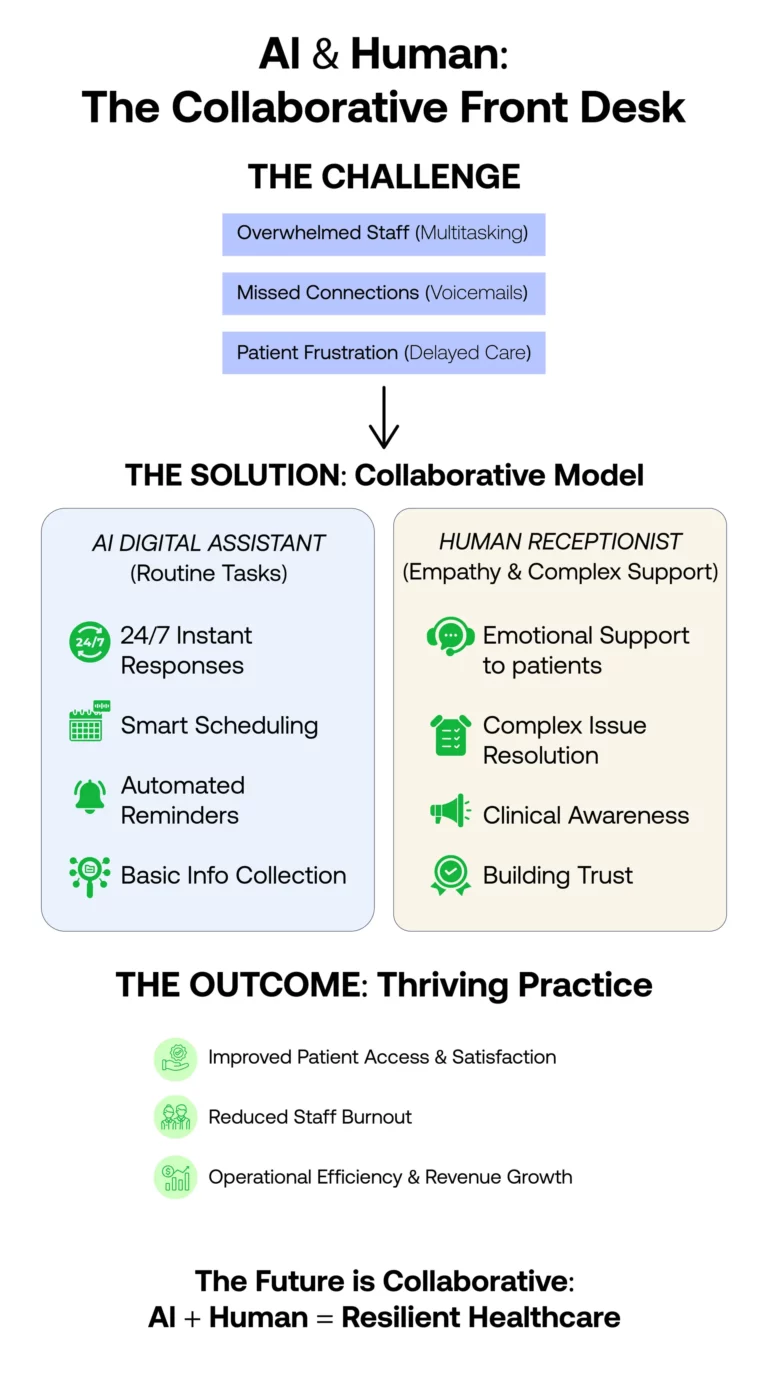
The future of the medical front desk is not human or AI, it is human and AI working together. As patient expectations continue to rise and healthcare operations grow more complex, practices need solutions that improve access without sacrificing care quality.
AI-enhanced front desk systems handle high-volume, routine interactions such as answering calls, scheduling appointments, confirming visits, and sharing basic practice information. This ensures patients receive immediate, accurate responses day or night without long wait times or unanswered calls.
At the same time, human front desk staff remain essential for situations that require empathy, clinical awareness, and nuanced decision-making. Patients facing complex medical concerns, emotional stress, or insurance-related questions still benefit from speaking with a knowledgeable person who understands their needs.
This collaborative model creates a better experience for everyone. Patients gain faster access and clearer communication, staff experience reduced workload and burnout, and practices operate more efficiently while protecting revenue and patient satisfaction.
By combining AI efficiency with human compassion, healthcare organizations can build a front desk that is responsive, resilient, and ready for the future.
Frequently Asked Questions
Q: What is an AI-enhanced front desk receptionist in healthcare?
A: An AI-enhanced front desk uses artificial intelligence to handle high-volume, routine patient interactions – including answering calls, scheduling appointments, sending reminders, and sharing basic practice information – 24/7, without replacing human staff for complex or emotional interactions.
Q: How many patient calls does the average medical practice miss?
A: Research shows the average medical practice misses between 34% and 42% of incoming calls during business hours – with 41% of those patients calling a competing practice rather than trying again, directly translating to lost appointments and revenue.
Q: Can AI reduce front desk burnout in healthcare?
A: Yes – a nationwide study of over 43,000 healthcare workers found that administrative staff face a burnout rate of nearly 46%, driven primarily by work overload; AI tools that automate routine scheduling and call-handling directly reduce that overload and delay burnout onset.
Q: Does CMS require medical practices to offer 24/7 patient access?
A: Yes – under 42 CFR $482.13, CMS requires providers to maintain 24-hour patient access to communication, meaning after-hours calls cannot simply go unanswered; AI receptionist tools help practices meet this regulatory requirement without overnight staffing.
Q: Will AI replace medical receptionists?
A: No – AI is designed to handle repetitive, high-volume tasks like scheduling and reminders, while human receptionists remain essential for empathetic, complex, and clinically sensitive conversations; the most effective model is a hybrid where AI and staff work together rather than one replacing the other.
Q: What types of tasks can an AI front desk handle in a medical practice?
A: AI front desk systems can answer inbound calls instantly, collect patient information, schedule and reschedule appointments based on provider rules, send SMS and email reminders, confirm visit details, and provide standard practice information – all without holding times or voicemail.
References
- PMC – Healthcare Staffing Shortages & Front Desk Impact: COVID-19 Workforce Study - 79.4% of practices reported staffing shortages; 32% reported front desk staff shortages specifically
- PMC – Work Overload & Burnout Across All Healthcare Role Types: 43,026-Worker Study - Work overload causes up to 2.9x greater burnout risk across clinical and non-clinical staff
- ONC / NCBI – Hospital Trends in AI Use: Billing & Scheduling Automation Data Brief (2023–2024) - AI-driven scheduling adoption rose from 51% to 67% of hospitals in a single year
- PMC – AI in Hospitals & Clinics: Administrative Accuracy & Patient Flow Efficiency (2024) - AI automation reduces manual errors and standardizes data capture across front desk operations
- PMC – AI Automation as a Burnout Mitigation Strategy in Healthcare Workforce (2024) - Automating routine admin tasks delays burnout onset and frees staff for patient-centered care
For more information, write to contact@medicalofficeforce.com
Transformation through AI which is rapidly becoming an essential need for truly productive outcomes in every sphere. Thank you for expanding on it in relation to the Front desk receptionist.
Great Information
Thanks for the informative overview.
Very informative—AI enhancing the workflows.
Love the information. We are living in the modernized world and introducing of AI in our clinic is really a steps ahead of other clinics.
Ai would certainly help making what’s good even better.
Great Information
Well said. AI as the front desk is a game changer for efficiency and access, especially in healthcare. streamlining workflows and reducing administrative burden.
A great explanation of how AI can relieve front desk pressure without losing the human connection. When routine calls are handled efficiently, staff can focus on patients who truly need personal support.
Informative.
True to the present world scenerio the one, AI is the future, and if we want to grow, we need to grow with it. It will definitely create a lot of good changes as part of the reception, which raises the revenue strength of the concern. This Great change=High growth aspects
Informative and perfectly explains how AI can improve access while preserving the human touch.
Very informative information.
The best insight is that by combining AI efficiency with human compassion, healthcare organizations can build a front desk that is responsive, resilient, and ready for the future.
Loved this post!
An excellent overview of the real challenges front desk teams face and how AI can support—not replace—the human touch while improving access, efficiency, and staff well-being.”
This really captures the reality of today’s front desk. AI works best when it removes friction, not people. Letting AI handle repetitive calls and scheduling gives staff the space to focus on empathy, problem-solving, and patient trust. That balance is what actually improves access, reduces burnout, and protects revenue. The future isn’t automated or manual, it’s collaborative.
Great article but we have to understand that future of the medical front desk is not human or AI, it is human and AI working together.
Better access for patients, better balance for staff. Very informative blog. Thanks for sharing.
AI empowers the front desk to work smarter—faster processes, fewer errors, and better patient experiences.
AI enhances front desk receptionists by automating routine tasks (scheduling, FAQs), enabling 24/7 availability, personalizing guest experiences with data, and routing complex queries to staff, freeing humans for higher-value interactions, boosting overall efficiency, reducing wait times, and improving customer satisfaction
Great article—AI isn’t replacing front desk staff, it’s empowering them to deliver faster, more efficient, and more patient-focused care.
Thanks for sharing these insights—thoughtful use of AI can support care teams, streamline workflows, and improve patient experiences and outcomes.
I am going to read this properly.
Great information!
Great Article, How AI effectively acting as a virtual front desk support to ensure continuously support with zero waiting time.
Thank you for sharing these valuable insights on how AI and collaboration can enhance patient access and care.
Thank you for sharing these valuable perspectives on how AI and people can work together to enhance patient access to care. The emphasis on collaboration highlights how technology, when thoughtfully integrated, can empower care teams, streamline experiences, and ultimately improve patient satisfaction and outcomes.
“A very informative and insightful read explaining how AI-powered front-desk systems significantly enhance operational efficiency, improve patient experience, and streamline workflow management.”
Informative and insightful blog
Great features. i am amazed to know how ai is enhancing practices.
A very informative read on how AI powered front desks clearly enhance efficiency
Great insights
Great insights on how AI is transforming front desk operations.
Article is explained very well!
This is a great breakdown of how AI can enhance access to care without losing the human connection. The hybrid model you described feels like the most practical and patient-friendly path forward.
Great article—AI isn’t replacing front desk staff, it’s empowering them to deliver faster, more efficient, and more patient-focused care.
Every ohysician owner need to read and decide is it time to modernized the clinic front desk? Love the information, thank you for sharing.