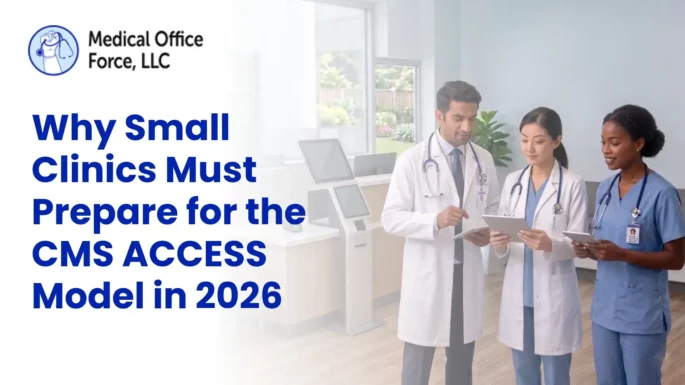
Why Small Clinics Must Prepare for the CMS ACCESS Model in 2026

Why Small Clinics Must Prepare for the CMS ACCESS Model in 2026

  • Subodh K. Agrawal, MD, FACC

    Medical Director, Medical Office Force LLC | Athens, Georgia
    Alumnus: SMS Medical College, Emory University, University of Alabama at Birmingham

The 50% Revenue Risk Small Practices Can’t Afford to Ignore

The healthcare payment landscape is shifting from “volume” to “value.” With the introduction of the CMS ACCESS Model in 2026, small clinics are no longer just competing on patient care – they are being evaluated on Outcome-Aligned Payments (OAP).

For independent practices, this shift is the difference between financial stability and a 50% revenue loss.

What is the CMS ACCESS Model?

The CMS ACCESS Model is a new value-based care initiative that introduces Outcome-Aligned Payments (OAP). Under this model, up to 50% of clinic revenue is tied directly to measurable patient outcomes, engagement levels, and efficiency metrics.

The “50% Withhold” Rule Explained

Unlike traditional fee-for-service models, the ACCESS Model splits payments into two tiers:
[See how these tiers compare to traditional FFS reimbursement models.]

50% Upfront Payment: Standard reimbursement for services rendered.

  1. 50% Performance-Based Tier: Funds held back by CMS and released only if the clinic meets specific Outcome Attainment Thresholds (OAT).
Infographic explaining the CMS ACCESS Model 50% withhold rule, showing the split between upfront payments and performance-based tiers for small clinics.

Key Challenges for Small Clinics in 2026

Large hospital systems have the overhead to manage complex reporting. Small clinics, however, face three critical “Risk Factors”:

      • Staffing Constraints: Limited front-desk support leads to missed calls and delayed follow-ups.
      • Manual Workflows: Reliance on paper or manual data entry results in missed reporting deadlines and inaccurate SST (Substitute Spend Adjustment) tracking.
      • Patient Leakage: When patients seek care outside your network due to slow response times, your clinical control and revenue both drop.

Why Patient Engagement is the Primary Revenue Driver

In an outcome-based economy, Engagement = Revenue. If a patient disengages, your outcomes suffer, and your withheld 50% remains with CMS. The Math of 2026: > Missed Patient Calls = Lower Engagement = Missed Outcomes = Lost Revenue.

How Automation Protects Your Bottom Line

To compete with larger systems, small clinics must adopt AI-driven healthcare automation. This is no longer a luxury; it is a compliance necessity.
      • AI Call Handling: Ensures 100% of patient inquiries are captured.
      • Automated Reminders: Reduces no-shows and improves OAT scores.
      • Integrated Reporting: Syncs clinical outcomes with CMS requirements automatically.

Action Plan: Preparing Your Clinic for the ACCESS Model

      1. Audit Your Communication: Identify your “Missed Call Rate.” Every missed call is a threat to your OAP.
      2. Digitize Patient Follow-ups: Implement automated systems to track care continuity.
      3. Monitor OAT Monthly: Do not wait for year-end reports. Use real-time dashboards to track performance.
      4. Eliminate Care Leakage: Use tech-enabled engagement to keep patients within your practice ecosystem.
Infographic showing a 50% revenue risk under the CMS ACCESS model

The Opportunity: Agility Over Scale

The CMS ACCESS Model rewards agility. Small clinics that leverage technology can respond faster, build deeper patient relationships, and maintain higher engagement rates than bloated hospital systems.

Conclusion: Adapt or Fall Behind

The CMS ACCESS Model is a fundamental shift in healthcare economics. By investing in patient engagement and AI-driven automation today, your clinic can secure its financial future and outperform the competition.

Frequently Asked Questions (FAQ)

How does the CMS ACCESS Model affect small clinic revenue?

It places up to 50% of total revenue at risk. This “withhold” is only paid out if the clinic meets specific patient outcome and engagement targets.

What is Outcome-Aligned Payment (OAP)?

OAP is a payment structure where a significant portion of reimbursement is tied to the quality of care and patient health results rather than the number of visits.

How can AI help clinics with the ACCESS Model?

AI handles high-volume tasks like patient scheduling, follow-up reminders, and data tracking, ensuring the clinic hits the engagement metrics required to trigger full payment.

Optimize Your Revenue with Medical Office Force

Stop losing revenue to missed calls and manual processes. Medical Office Force specializes in helping small clinics navigate the CMS ACCESS Model.

      • Zero Missed Calls
      • Automated Patient Engagement
      • Reduced Care Leakage

Book Your CMS Readiness Demo Today

A Complete Guide to CMS ACCESS Model Outcome-Aligned Payments (OAP)

cms access model payment oap explained

A Complete Guide to CMS ACCESS Model Outcome-Aligned Payments (OAP)

CMS ACCESS Model Payment Explained: A Physician’s Guide to Outcome-Aligned Payments (OAP)

  • Subodh K. Agrawal, MD, FACC

    Medical Director, Medical Office Force LLC | Athens, Georgia
    Alumnus: SMS Medical College, Emory University, University of Alabama at Birmingham

What is the CMS ACCESS Model Payment Structure?

Summary: The CMS ACCESS Model replaces fee-for-service volume with Outcome-Aligned Payments (OAP), where up to 50% of revenue is tied to hitting clinical targets over a 12-month care period.

              • Patient engagement directly impacts financial success
              • Reporting compliance is critical
              • Technology adoption is essential for scalability

The Centers for Medicare & Medicaid Services (CMS) is reshaping reimbursement with the ACCESS Model, starting July 2026. This system introduces Outcome-Aligned Payments (OAP), a system that rewards physicians based on measurable patient outcomes rather than the sheer volume of services provided.

If you’re new to the model, start with our complete guide on what the CMS ACCESS Model is.

As a practicing cardiologist, I know that a “new payment model” often translates to an added administrative burden. However, understanding how OAP payments work is the only way to protect your practice’s cash flow while delivering high-quality, coordinated care.

What Are Outcome-Aligned Payments (OAP)?

Outcome-Aligned Payments (OAP) are recurring, per-beneficiary payments designed to incentivize clinical success. 

Under this model, CMS pays for results, such as:

      • Improved patient outcomes: (e.g., Systolic Blood Pressure < 130 mmHg).
      • Patient Engagement: Reducing “care leakage” to outside providers.
      • Integrated Care: Managing comorbidities across cardio, kidney, and metabolic tracks.

This marks a major shift from traditional systems. You can explore our deep dive into CMS ACCESS Model vs. Fee-for-Service (FFS) here.

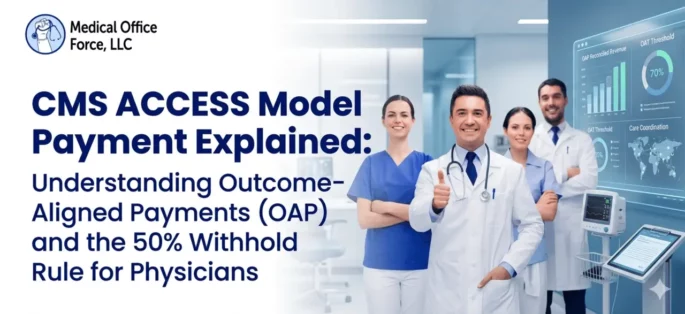
CMS ACCESS Model payment infographic showing Outcome-Aligned Payments OAP, 50 percent withhold rule, clinical tracks CKM eCKM BH MSK, and performance-based reimbursement

How the ACCESS Model Payment Structure Works

The ACCESS Model divides payments into two key phases:
  1. Initial Period (First 12 Months): 
  • Higher reimbursement tier
  • Covers onboarding, care coordination, and early clinical improvement
  • Focused on achieving the first measurable patient outcome 
  1. Follow-On Period: 
  • Lower ongoing payments
  • Focuses on maintaining patient stability and long-term outcomes

Table 1: Annual Allowed Amounts (80% Medicare / 20% Coinsurance)

Clinical Track Initial Period (Annual) Follow-On Period (Annual)
Early Cardio-Kidney-Metabolic (eCKM) $360 $180
Cardio-Kidney-Metabolic (CKM) $420 $210
Behavioral Health (BH) $180 $90
Musculoskeletal (MSK) $180 N/A (No Follow-On)

NOTE: 

For eCKM and CKM patients in rural areas, CMS adds a $15 fixed payment during the Initial Period to offset the costs of distributing connected devices like blood pressure cuffs and wearables.

The 50% Withhold Rule: Your Practice’s Risk vs. Reward

The most critical detail for practice managers is the 50% withhold. CMS pays only half of the Medicare portion monthly; the rest is reconciled after 12 months.

To receive that second 50%, practice must meet the two targets:

      1. Outcome Attainment Threshold (OAT): 50% Target
        At least 50% of your aligned patients must meet their clinical goals (e.g., 15 mmHg SBP reduction or 1% HbA1c drop).
      2. Substitute Spend Adjustment (SST): 90% Threshold
        This penalizes “care leakage.” If your patients seek defined “substitute” services from outside providers above the 90% threshold, your reconciled payment is reduced.

Dr. Agrawal’s Insight: From my experience at Emory and UAB, I’ve seen how patient leakage happens when communication breaks down. In this model, if a patient goes elsewhere for a psych eval or a device setup that you were supposed to coordinate, it costs you directly.

Reporting Requirements in the ACCESS Model

Data compliance is now a prerequisite for payment. Timely reporting is critical for maintaining eligibility and payments.

      • Baseline Data:
        Must be submitted via FHIR API within 60 days of alignment. Miss this, and the patient is unaligned, meaning you cannot bill.
      • Quarterly Reporting:
        Required every 70–110 days to maintain active billing status.
      • End-of-Period Reporting:
        For MSK and Behavioral Health tracks
        → Success can be reported at 180 days
        → Continued payments if patient remains stable
CMS ACCESS Model payment infographic showing Outcome-Aligned Payments OAP structure, 50 percent withhold rule, and value-based care workflow.

Challenges Physicians Will Face

Transitioning to the ACCESS Model comes with operational challenges:

      • Increased data tracking requirements
      • Higher dependency on technology systems
      • Risk of patient leakage affecting revenue
      • Administrative complexity in reporting

How to Succeed Under the ACCESS Model

To thrive under this payment structure, practices must shift from reactive to proactive engagement.

Key strategies:

      • Automate Outreach: You cannot manually call every patient to check their BP. You need AI-driven systems (Implement automated patient communication systems).
      • Remote Patient Monitoring (RPM): Use the rural add-on to fund the devices that provide the data you need for the OAT (Invest in remote patient monitoring (RPM))
      • Clinical Oversight: Ensure your Medical Director is reviewing outcomes quarterly, not just at the end of the year.
      • AI Call Handling: Use AI-driven call handling to reduce missed patient interactions.

Why Patient Engagement is Critical in OAP Models

Under Outcome-Aligned Payments, success depends on keeping patients consistently engaged.

If patients:

      • Miss follow-ups
      • Seek care elsewhere
      • Drop off from care plans

→ Your performance metrics and payments might suffer.

Expert Insight from Dr. Agrawal

This model makes active care delivery non-negotiable.

If you lose track of a patient and they receive care elsewhere, it’s not just a clinical gap, it’s a direct financial loss under the reconciliation model.

Conclusion: Opportunity or Risk?

The CMS ACCESS Model is a fundamental shift. For physicians in Georgia and across the country who are willing to embrace tech-enabled care, it offers: 

      1. a predictable, 
      2. monthly revenue stream. 

For those who stay with manual processes, the 50% withhold represents a significant financial risk.

FAQ: CMS ACCESS Model Payment

What is CMS ACCESS Model payment?
It is a value-based payment system where physicians are reimbursed based on patient outcomes instead of service volume.

What are Outcome-Aligned Payments (OAP)?
OAPs are payments tied to achieving measurable clinical improvements in patients.

What is the 50% withhold rule?
CMS pays 50% upfront and holds the rest until performance metrics are met at the end of the care period.

What happens if reporting deadlines are missed?
Patients may become unaligned, and providers may lose the ability to bill for their care.

How can practices improve ACCESS Model performance?
By improving patient engagement, reducing care gaps, and adopting technology solutions for communication and monitoring.

Call to Action (CTA)

If your practice is preparing for the CMS ACCESS Model, now is the time to strengthen your patient engagement and communication strategy.

At Medical Office Force, we help healthcare providers:

      • Reduce missed patient calls
      • Improve care continuity
      • Increase patient engagement
      • Support value-based care success

Book a Demo Today and see how our AI-powered voice solutions can help you succeed under outcome-based payment models.

References

What is CMS ACCESS (Advancing Chronic Care with Effective, Scalable Solutions) Model?

What is CMS ACCESS (Advancing Chronic Care with Effective, Scalable Solutions) Model?

  • Subodh K. Agrawal, MD, FACC

    Medical Director, Medical Office Force LLC | Athens, Georgia
    Alumnus: SMS Medical College, Emory University, University of Alabama at Birmingham

Summary

The ACCESS Model is a 10-year voluntary Medicare initiative designed to scale chronic care management through technology and Outcome-Aligned Payments (OAP). According to the official CMS ACCESS Model overview, it focuses on four clinical tracks and ties 50% of reimbursement to measurable clinical improvements.

The CMS Innovation Center (CMMI) introduced the Advancing Chronic Care with Effective, Scalable Solutions (ACCESS) Model to transform how Medicare beneficiaries with chronic conditions receive care. This model moves away from Fee-For-Service (FFS) toward a “scalable,” digital-first approach.

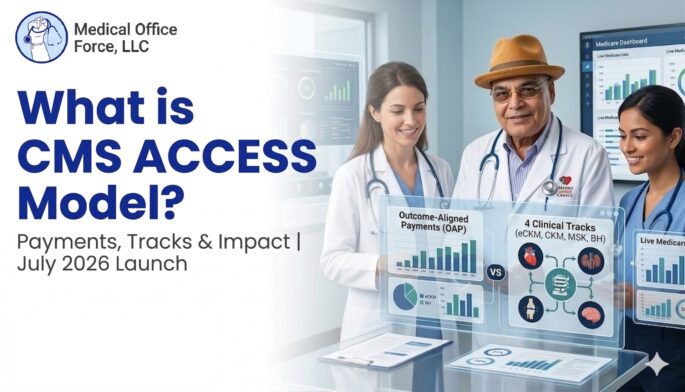
The 4 Clinical Tracks of the ACCESS Model

The model is structured around four distinct tracks. Practices can participate in one or more, depending on their specialty:

  • Early Cardio-Kidney-Metabolic (eCKM): Focuses on hypertension, obesity, and pre-diabetes management.

  • Cardio-Kidney-Metabolic (CKM): Designed for patients with established heart disease, CKD (Stage 3), and Type 2 diabetes.

  • Musculoskeletal (MSK): Targets chronic pain and joint health management.

  • Behavioral Health (BH): Focuses on depression, anxiety, and integrated mental health care.

The Payment Logic: How Do OAPs Work?

The ACCESS model utilizes Outcome-Aligned Payments (OAPs) instead of traditional care management codes (like CCM or RPM). As detailed in the CMS Financial Structure and Clinical Performance guide, the payments are two-tiered:

  • Year 1 (Initial Year): A higher payment range ($180 – $420 per patient) to cover technology onboarding.

  • Follow-on Years: A lower maintenance payment range ($90 – $210 per patient).

  • The 50% Clinical Outcome Adjustment: CMS withholds half of the payment, only releasing it if specific benchmarks (like blood pressure or A1C control) are met.

Key Deadlines for 2026

  • April 1, 2026: Application deadline for the first cohort.

  • July 5, 2026: Official launch of the first performance year.

  • 2033: Expected conclusion of the 10-year test period.

Frequently Asked Questions (FAQ)

How does ACCESS coordinate with my Primary Care Provider?

The model is designed to complement traditional care. Referring clinicians can receive electronic updates on patient progress and may bill a new co-management payment for reviewing these updates and coordinating care.

What are the technical requirements for participants?

Organizations must use secure, interoperable systems, including CMS APIs for enrollment and reporting. They must also designate a physician Clinical Director to oversee quality and compliance. Learn more about IT Infrastructure Support here.

What is the “FFS Exclusion Policy”?

CMS prevents “double-dipping.” If a patient is aligned with an ACCESS participant for a specific condition, other providers cannot bill overlapping services like Chronic Care Management (CCM) or Remote Patient Monitoring (RPM) for that same condition.

Strategic Verdict

The ACCESS model offers massive scale but creates a significant revenue gap for traditional clinics. Before transitioning, you must analyze your billing data.

For a deeper look at the $2,000 revenue gap this model creates, read our full analysis on High-Touch vs. High-Tech Scale here.

Schedule a Revenue Protection Audit today to see how your practice can survive these Medicare changes.