What Clinic Owners Need to Understand Before Choosing the Right Communication System
Healthcare communication is changing rapidly. Medical practices today are under pressure to answer every patient call, reduce front desk overload, improve scheduling efficiency, and maintain patient satisfaction at the same time. This has led many clinic owners to explore two major solutions: Remote patient schedulers and AI voice agents.
At first glance, both seem similar because both help manage patient communication. But operationally, financially, and strategically, they are very different systems. Understanding those differences is critical before investing in either solution.
What Is a Remote Patient Scheduler?
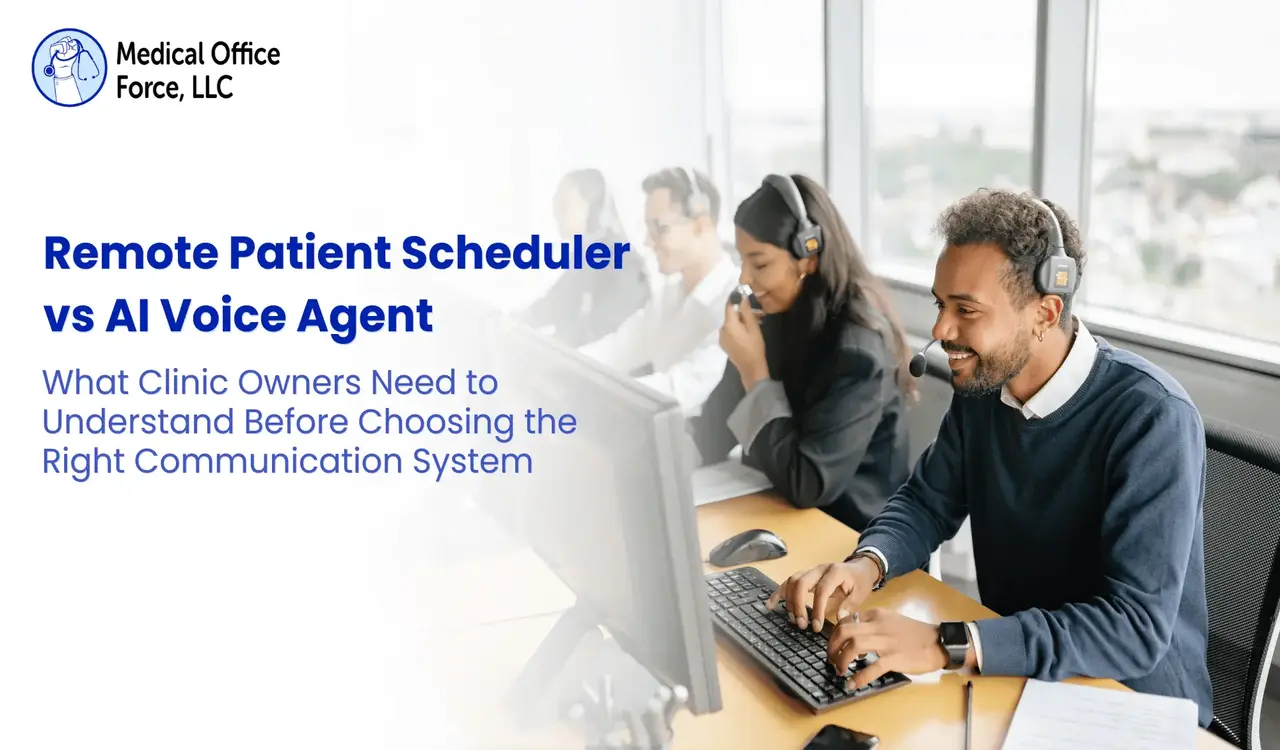
A remote patient scheduler is a real person working off-site who handles tasks such as:
- Appointment scheduling
- Call answering
- Patient reminders
- Basic intake communication
They function similarly to a traditional front desk staff member, except they work remotely instead of inside the clinic. This model helps practices expand staffing without adding physical office space.
What Is an AI Voice Agent?
An AI voice agent is an automated communication system that uses artificial intelligence to interact with patients naturally over the phone. They can:
- Answer calls instantly
- Schedule appointments
- Route urgent issues
- Handle repetitive patient questions
- Operate continuously without breaks
Unlike traditional scheduling staff, AI systems do not rely on manual availability to answer incoming calls.
The Biggest Difference Is Availability
A remote scheduler can only handle one conversation at a time, whereas an AI voice agent can handle multiple simultaneous calls instantly. This becomes especially important during:
- Morning call surges
- Lunch hours
- After-hours communication
- High patient volume periods
One of the largest causes of missed revenue in healthcare remains unanswered patient calls. As our medical director noted in our diagnostic on The $144,000 Silent Leak, even a small number of missed calls daily translates directly into massive annual revenue losses.
Research supported by the American Medical Association highlights the growing importance of digital systems that reduce operational inefficiencies and administrative burden. Clinic owners can review these industry insights directly via the AMA Digital Health Study.
Human Interaction vs. Immediate Access
Many clinic owners initially assume patients always prefer speaking with humans, but patient behavior tells a different story. Patients primarily value:
- Immediate response
- Clear communication
- Fast scheduling
- Reduced hold times
Long wait times often create more frustration than interacting with technology. This is one reason AI patient communication systems are growing rapidly across healthcare operations.
Cost Structure & Operational Comparison
| Operational Area |
Remote Patient Scheduler |
AI Voice Agent |
| Financial Plan |
Hourly wages & training costs |
Automated operation & minimal ongoing management |
| Availability Limits |
Coverage limitations; one call at a time |
24/7 availability; multiple simultaneous calls |
| Staffing Vulnerabilities |
Turnover challenges |
Consistent, predictable performance |
Where Remote Schedulers Still Provide Value
Human communication still matters deeply in healthcare. Remote schedulers remain essential for:
- Complex patient conversations
- Insurance coordination
- Emotionally sensitive interactions
- Detailed scheduling exceptions
The question is not whether humans or AI are better. The real question is which tasks should be handled by each system.
Why Many Clinics Are Moving Toward Hybrid Models
The most effective modern practices are not replacing humans entirely; they are combining both systems strategically. AI voice agents manage repetitive, high-volume communication while human staff focus on higher-level patient support. This balanced architecture delivers:
- Better efficiency
- Reduced burnout
- Improved responsiveness
- Stronger patient experience
HIPAA and Security Considerations
One major concern for clinic owners is patient privacy. Any communication system handling patient information must follow HIPAA compliance standards.
According to the U.S. Department of Health and Human Services (HHS), healthcare communication systems must protect sensitive patient information through secure handling and controlled access. You can review the underlying legal frameworks directly on the HHS HIPAA Compliance Portal.
Which System Is Right for Your Practice?
The answer depends on your unique operational challenges.
Consider an AI Voice Agent if your practice faces:
Consider a Remote Scheduler if your practice requires:
- Detailed, highly variable patient interaction
- Complex, multi-layered scheduling coordination
- High levels of personalized, human communication
In many cases, the best solution combines both.
A Simple Self-Assessment
Does your practice struggle with unanswered calls?
Your answers usually reveal which communication gaps need the most attention.
Frequently Asked Questions
1. Are AI voice agents replacing medical staff?
No. Most practices use AI to support staff rather than eliminate human roles.
2. Can AI handle patient scheduling accurately?
Yes. Modern systems can manage scheduling workflows efficiently and consistently.
3. Do patients prefer AI or humans?
Most patients prefer fast responses and reduced waiting times over long human hold queues.
4. Is a remote scheduler more personal?
Human interaction can feel more personalized for complex conversations.
5. Can AI work after clinic hours?
Yes. AI voice agents operate continuously without downtime.
6. Are AI systems HIPAA compliant?
Healthcare-specific AI systems can be designed to meet HIPAA compliance standards.
7. Which option is more cost-effective long term?
This depends on patient volume, staffing costs, and operational requirements.
The Bottom Line
Remote patient schedulers and AI voice agents are not direct competitors. They solve different operational problems inside the modern medical practice.
The future of healthcare communication will likely combine both human support and intelligent automation to improve patient access, efficiency, and operational stability. Practices that adapt early will be better positioned for long-term growth.
Take the Next Step
If your clinic is evaluating communication solutions, the goal should not simply be automation. It should be building a patient communication system that is responsive, scalable, secure, and sustainable.
Medical Office Force helps practices implement modern communication strategies that combine operational efficiency with exceptional patient experience. Because in healthcare, accessibility is no longer optional. It is part of quality care.


Good comparison of AI voice agents and remote schedulers for healthcare communication.